
Every enterprise data platform now says it uses AI.
That claim is easy to make. It is harder to explain what the AI actually does, where it runs, how people govern its recommendations, and what evidence proves it improved the result.
Gartner reports that 63% of organizations either do not have, or are unsure whether they have, the right data management practices for AI. Gartner also predicts that through 2026, organizations will abandon 60% of AI projects unsupported by AI-ready data.
The model is not always the problem. AI initiatives often stall because the data foundation is weak: unclear definitions, incomplete metadata, hidden duplicates, weak sensitive-data controls, and no proof that trusted data reached the target.
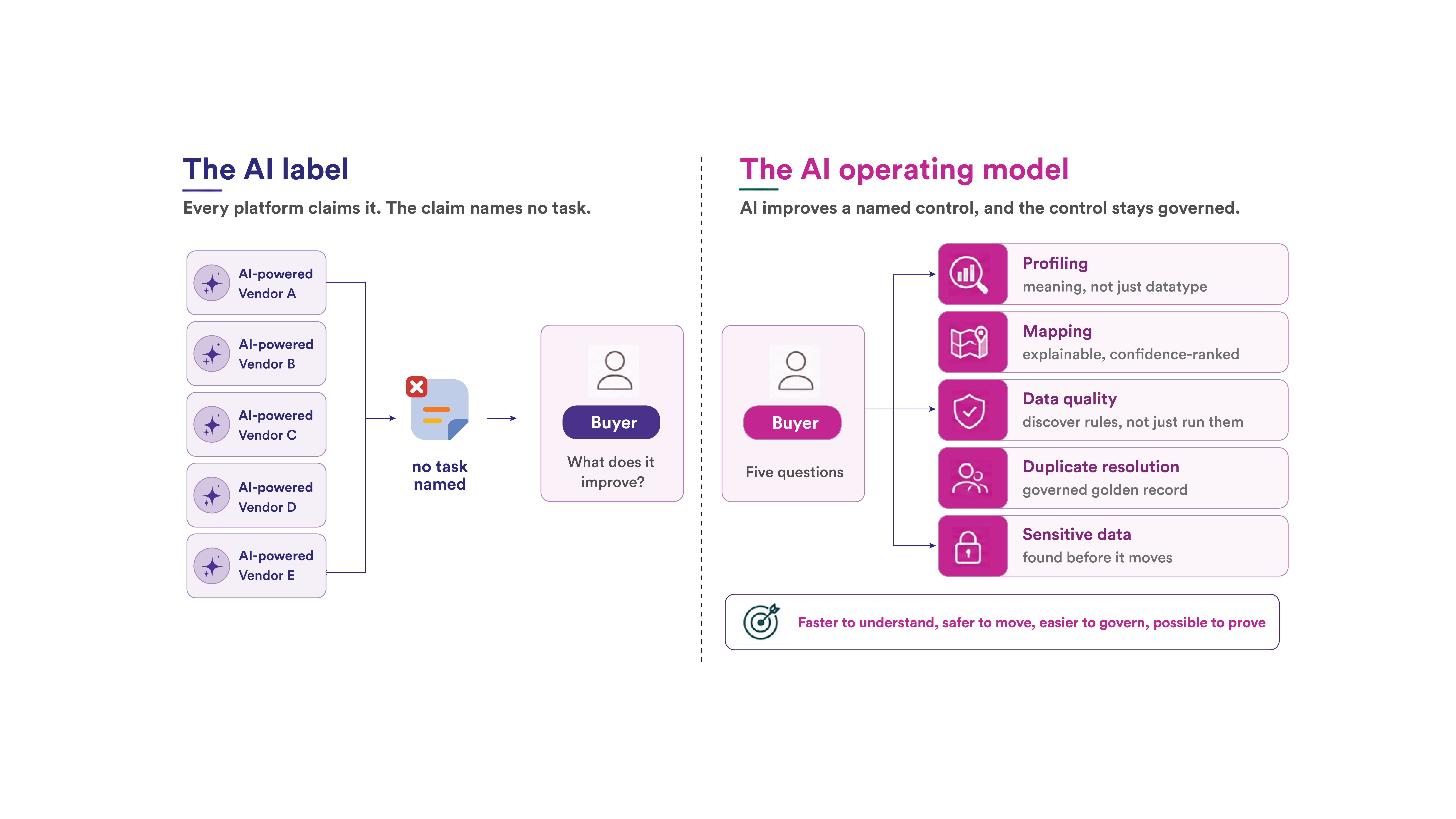
“AI-powered” has become a soft label in enterprise software.
AI can classify columns, suggest mappings, detect anomalies, recommend quality rules, resolve duplicate entities, and flag sensitive data. The issue is that the label does not say which of those things is actually happening.
A platform may use deterministic rules, workflow automation, templates, statistical profiling, machine learning, embeddings, large language models, or a mix. Each approach brings a different level of accuracy, transparency, control, and business value.
That distinction matters because AI language is increasingly used as a marketing shortcut. The SEC has charged firms for false and misleading statements about their use of AI, warning against “AI washing.”
So the buying question is not, “Does the platform use AI?” It is: what task does the AI perform, what input does it use, what output does it produce, how confident is it, how does a human validate it, and what improves over the baseline?
For AI to be trusted in a data platform, the capability must be:
That is the difference between naming an AI mechanism and proving that it creates value.
A data preparation pipeline is a sequence of controls: profiling, classification, mapping, validation, cleansing, deduplication, sensitive-data protection, loading, and reconciliation.
AI adds value only when it improves one of those controls. Use the table below as the evaluation lens.
These are not cosmetic questions. They reveal whether AI improves the controls data teams rely on every day.
Semantic profiling checks whether the platform understands meaning, not just structure. A field may technically be a string, but it could contain a customer name, tax ID, supplier code, bank account, or free-text comment.
Mapping checks whether the platform understands context, not just similar field names. Good AI assistance should compare metadata, sample values, business meaning, and transformation logic before suggesting a match.
Quality rules check whether AI can reduce manual rule writing without removing governance. The goal is not automatic enforcement. The goal is faster rule discovery, backed by evidence, testing, approval, versioning, and auditability.
Duplicate resolution checks whether the platform can move beyond exact matches. It should help identify likely duplicates, explain why records matched, and support clear rules for how the final golden record is chosen.
Sensitive-data detection checks whether protection starts before data moves. AI should help identify personal, financial, employee, or regulated data hidden in unexpected fields, then trigger the right control such as masking, encryption, quarantine, or approval.
A real AI-ready data platform does not only find issues. It helps control what happens next.
Ready to Test Your AI Data Controls? Assess your AI-ready data foundation with ChainSys.
The real test is not whether a platform says it uses AI.
It is whether AI improves the controls where enterprise data actually breaks: profiling, mapping, quality, duplication, sensitive data, governance, and reconciliation.
That is where ChainSys fits.
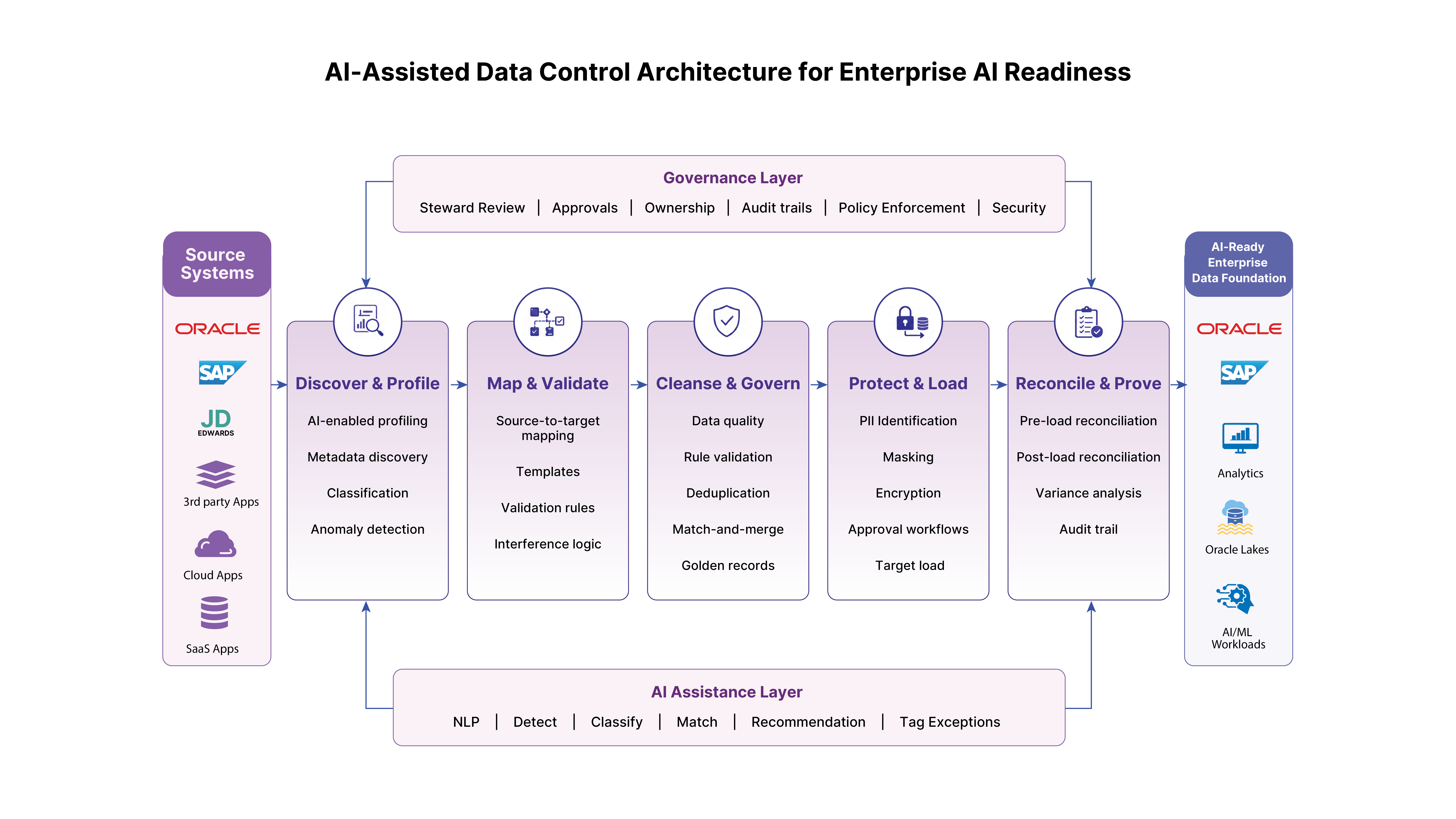
Oracle describes ChainSys Smart Data Platform on OCI as enabling companies to migrate, integrate, catalog, and analyze enterprise application data. Oracle also identifies dataZap for migration, integration, and reconciliation; dataZen for data quality, MDM, and governance; and dataZense for analytics, visualization, and cataloging.
The mapping below connects the five evaluation questions to ChainSys capabilities documented across Oracle and ChainSys sources, including dataZense cataloging and metadata discovery, dataZap templates and data quality assurance, dataZen cleansing and MDM, and ChainSys PII profiling and masking.
This is the difference between an AI label and an AI operating model.
ChainSys applies AI where it accelerates discovery, recommendation, detection, cleansing, and exception handling, while keeping stewardship, approval, governance, and reconciliation in the control path.
AI should make data faster to understand, safer to move, easier to govern, and possible to prove.
Building an AI-ready data foundation is not about choosing the platform with the loudest AI claim. It is about creating a governed data management architecture where AI improves the controls that matter: profiling, mapping, validation, cleansing, duplicate resolution, sensitive-data protection, and reconciliation.
From semantic profiling and source-to-target mapping to AI-assisted data quality, MDM, PII identification, and audit-ready reconciliation, ChainSys brings intelligence, automation, and governance into every step of the enterprise data lifecycle.
With AI-powered ChainSys products: dataZap, dataZen, and dataZense, it helps organizations move beyond AI labels and build data foundations that are faster to understand, safer to move, easier to govern, and possible to prove, whether the data sits in Oracle, SAP, legacy systems, cloud applications, analytics platforms, or AI pipelines.
ChainSys: Migrate. Govern. Connect. Trust.
Data fit for a specific AI use case: sufficient, representative, structured for the model, and traceable to its source.
Because of the data, not the model. Gartner ties 60% of abandoned AI projects to inadequate data foundations.(Gartner)
AI can assist with source-to-target mapping, validation, cleansing, exception handling, and reconciliation, reducing manual effort and improving control.
Identifying records that refer to the same real-world entity without an exact match, then merging them into one golden record.
What it does at each stage: profiling, mapping, rule generation, match and merge, PII detection. And how much of each is automated.
Partner with ChainSys to turn AI-readiness from a strategy discussion into an operational data foundation.
Our experts can help you assess your current data controls, identify gaps across profiling, mapping, quality, MDM, sensitive-data protection, and reconciliation, and define a practical roadmap for trusted enterprise AI.
👉 Get in touch today to schedule your demo.
Let’s make your data AI-ready. Let’s make it ready to trust.