Oracle AI agents retrieve context, recommend actions, and execute work across enterprise processes. Duplicate suppliers, incomplete customer profiles, conflicting product attributes, and outdated hierarchies can produce unreliable outcomes and weaken confidence in automated workflows.
ChainSys helps organizations establish the quality, MDM, and governance controls that give agents clearer, accountable business context.
Planning an Oracle AI initiative? Start with a focused data-readiness assessment to identify the quality and governance gaps that could affect agent outcomes. Talk to ChainSys.
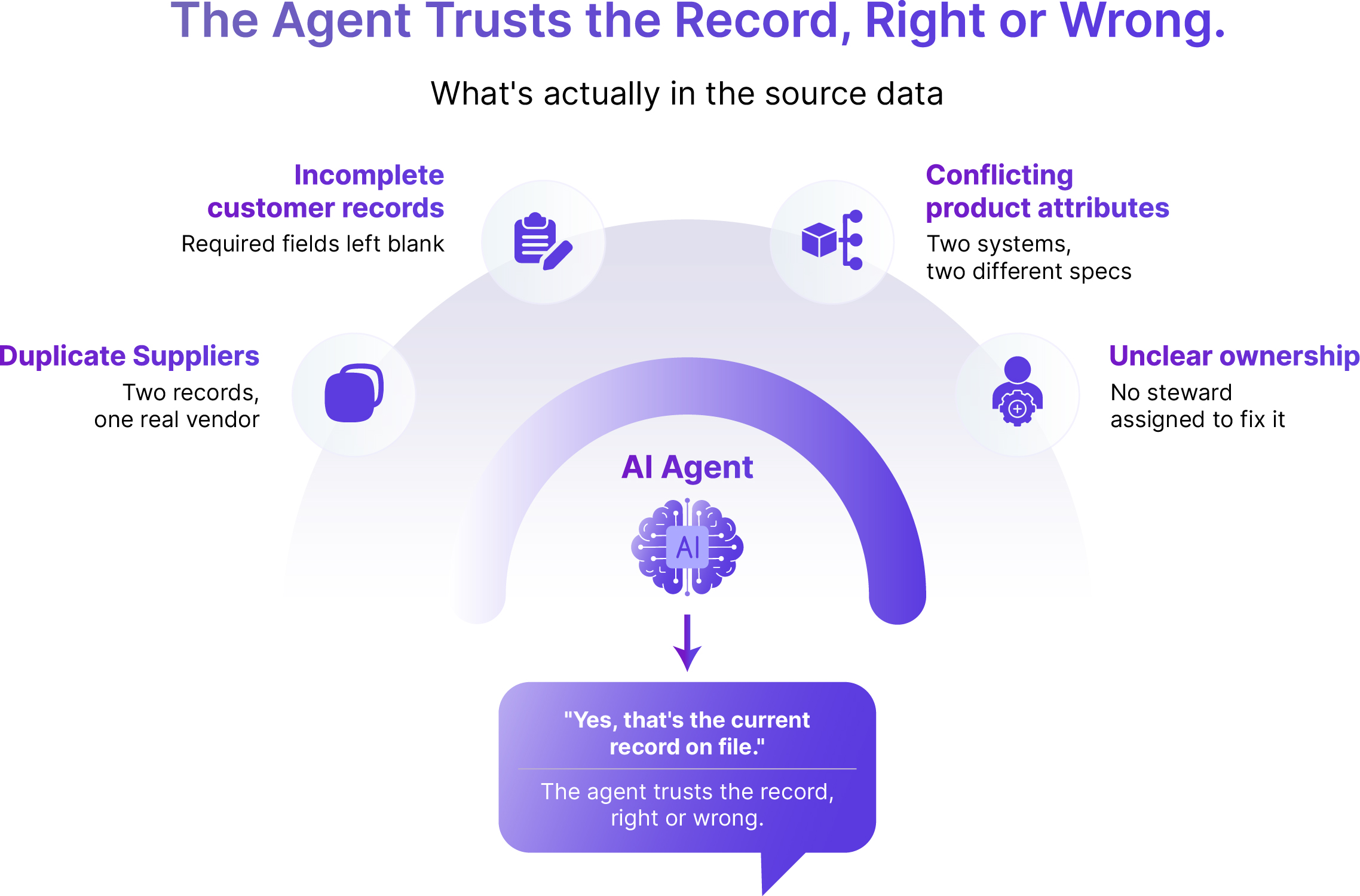
Duplicate suppliers. Incomplete customer records. Conflicting product attributes. Unclear ownership.
These may look like familiar data-management problems. But when an Oracle AI agent retrieves, interprets, or acts on data affected by these issues, they become operational risks. Reliable AI starts with reliable business data.
Oracle AI Agent Studio for Fusion Applications enables organizations to create, extend, deploy, and manage AI agents and agent teams across enterprise workflows.
But scaling AI depends on more than the agent or the model. It depends on whether the underlying data carries complete, consistent, and relevant business context. In its AI data readiness research, McKinsey found that more than two-thirds of high-performing companies identify data, rather than the model, as the primary obstacle to scaling AI.
That makes data quality for Oracle AI agents a business priority, not just a data-team concern. AI agents can operate within governed workflows, but they still depend on the accuracy, completeness, consistency, and timeliness of the data they consume. IBM also reports that 43% of chief operations officers surveyed identified data-quality issues as their most pressing data-management challenge.
Before deploying an AI agent, assess whether the business data it will use is complete, consistent, governed, and accountable.
Traditional analytics helps people identify a pattern. AI agents can retrieve enterprise context, recommend actions, and participate in multi-step workflows.
That makes data quality matter even more.
A procurement agent may identify suppliers for a purchase decision. If supplier records are duplicated, tax details are inconsistent, or parent-child relationships are unclear, it may retrieve incomplete or conflicting supplier context.
Similarly, a service agent may miss interactions held under fragmented customer profiles. A planning agent may assess availability using conflicting product attributes. An agent may not recognize or flag every data gap. It begins with the context it is given, and can sound confident even when that context is inconsistent.
Oracle’s Fusion Agentic Applications are designed to make and execute decisions using enterprise data, workflows, policies, approval hierarchies, permissions, and transactional context. This brings clean records, governed definitions, and accountable ownership essential to responsible AI adoption.
These five questions help assess whether Oracle data is ready for AI-agent use. Apply them to any business entity before an agent begins working with it.
The key question is not whether an organization can build an agent. It is whether its data can support reliable outcomes.
The same principle applies to the documents, knowledge sources, and metadata that agents use for retrieval and reasoning.
So the data is cleansed once and fed to AI agents. Is that all? A one-time cleansing effort may improve a data set before an AI pilot. It does not ensure that records remain dependable as data continues to change.
Data reliability needs to become a continuous operating capability, rather than a one-time activity.
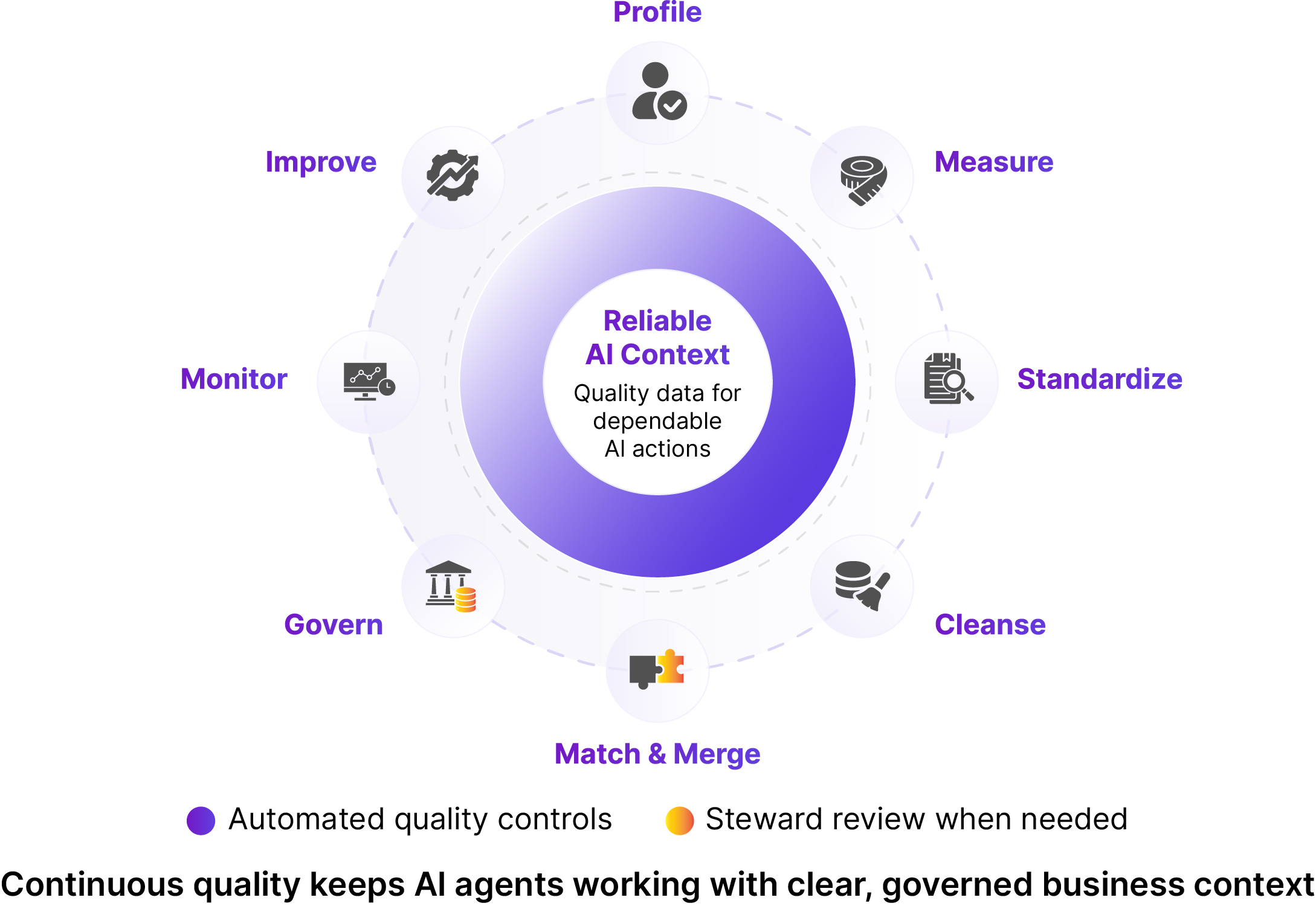
Profile → Measure → Standardize → Cleanse → Match and Merge → Govern → Monitor → Improve
Every stage has its purpose.
Automation should not make every decision independently. Stewards should review uncertain matches, corrections, and survivorship decisions. The goal is to reduce manual effort while preserving accountability.
ChainSys provides the data-quality, MDM, and governance capabilities needed to strengthen the business context available to Oracle AI agents.
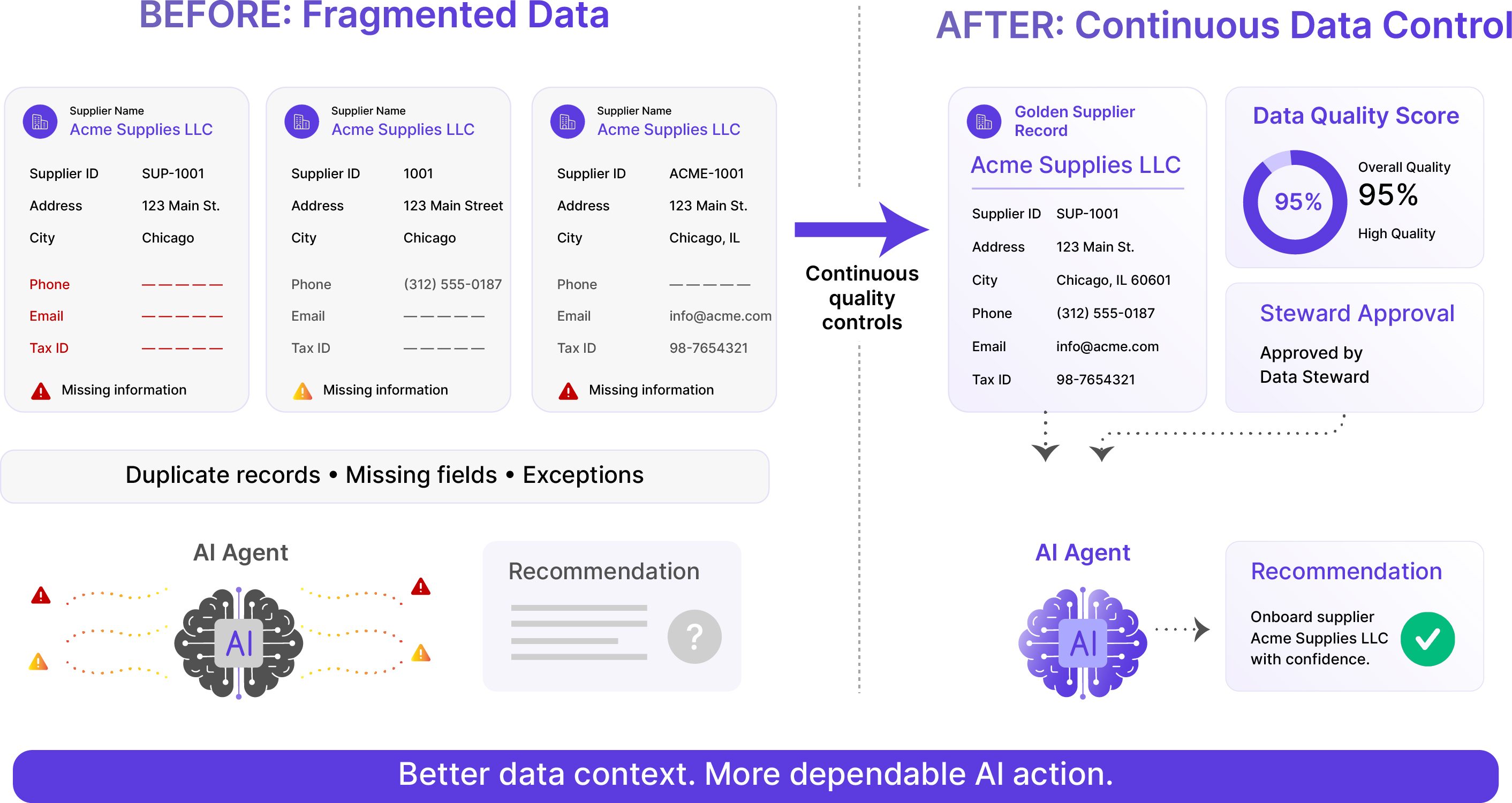
Consider a supplier-management use case. Before an AI agent helps procurement teams identify suppliers or investigate purchase exceptions, ChainSys capabilities can assess supplier completeness, validate required tax and address details, standardize values, and identify duplicate records. Where records conflict, a data steward can review the exception and approve the governed supplier record.
The result is not merely cleaner supplier data. It is a stronger context for the agent and more confidence for the people acting on its output.
The architecture connects source systems and Oracle applications to quality, MDM, and governance controls, then to governed business data, AI agents, and steward feedback. It strengthens the data layer so agents work with more consistent business context.
This approach complements Oracle's focus on governance, testing, approvals, auditability, and secure access within AI-driven workflows.

Not every domain needs attention on day one. Start with the one where a bad record does the most damage if an agent acts on it.
Pick one domain. Define what complete and valid mean for one domain. Assign an owner, build a governed record, prove the result, then expand.
ChainSys helps enterprises make data faster to understand, safer to use, easier to govern, and possible to prove.
Its capabilities bring together data-quality assessment, cleansing, standardization, MDM, match-and-merge, governed golden records, stewardship, and auditability. This enables organizations to address the data conditions that influence AI-agent outcomes without treating governance as a final compliance step.
Oracle AI agents cannot create data reliability on their own. They depend on it.
Organizations that want dependable AI outcomes need disciplined data quality, master-data control, governance, continuous monitoring, and human accountability. ChainSys helps establish these foundations, so Oracle AI agents can work with clearer, more consistent, and more governable enterprise context.
They retrieve context and support actions. Incomplete, duplicate, or inconsistent records weaken their outputs.
They can, but the context may be conflicting or incomplete. Deduplication and governed golden records reduce this risk.
MDM creates one governed view of customers, suppliers, products, and employees.
ChainSys continuously profiles, cleanses, standardizes, deduplicates, and governs data, combining steward oversight and audit trails for accountable AI readiness.