A small change rarely stays in one application
An item attribute changes in Oracle Product Management. Later, Inventory reports a mismatch, an order uses the wrong unit of measure, or Costing produces an unexpected result.
Each team investigates its own application because the screen does not show where the value originated. What looks like an isolated gap, approval or accounting issue often began in an unmapped relationship elsewhere.
The real challenge is not just finding the data. It is understanding the relationships behind it. This blog explores what the data connects to, how those connections work, and what could be affected when they change.
Oracle applications are connected through shared master data, organizational structures, reference values, approval hierarchies, effective dates and accounting rules. Those connections are difficult to see because:
Interface specifications document parts of this landscape, but rarely explain the rules and intermediate objects that keep a process working.
These shared objects create relationships that extend well beyond the application where they are maintained.
Think of a parcel moving through several sorting hubs. The screen at one hub tells you where the parcel is now. It does not show whether the address was wrong at the start, which routing rules were applied or where the parcel goes next. Oracle data works in a similar way. A problem may appear in one application even though it began somewhere else.
In Oracle's party model, one organization can link to accounts, contacts, sites, supplier records and tax registrations. If “ABC Corp” and “ABC Corporation” are created separately, histories may split, complicating invoice matching and increasing duplicate-payment risk.
Accounting brings more handoffs. Transactions from Payables, Receivables, Assets, Projects, Costing and Payroll can pass through Subledger Accounting before reaching the General Ledger. For a purchase-order-matched invoice:
Purchase order → Receipt, where required → Invoice → Invoice distributions → Subledger journal → General Ledger
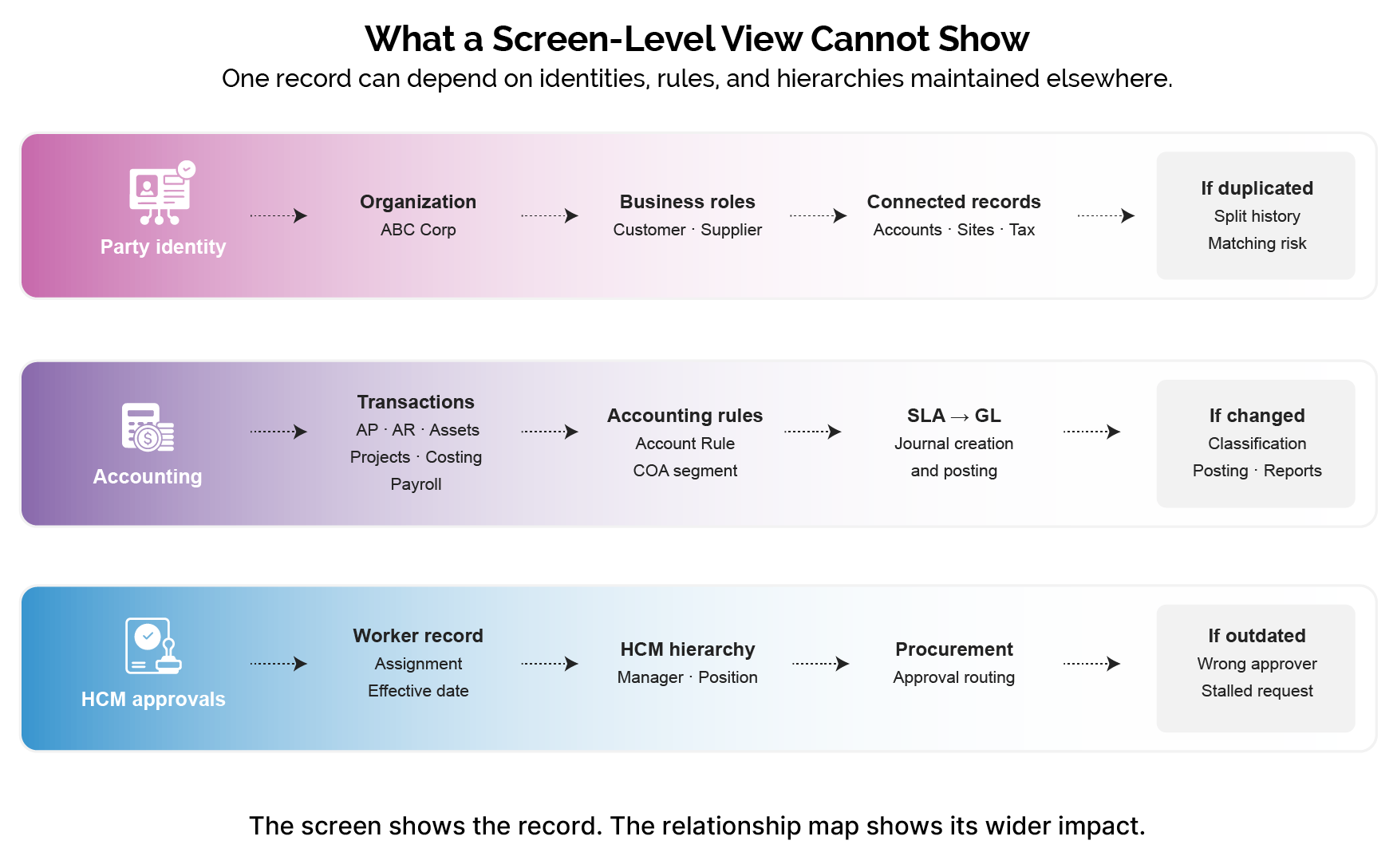
Payment creates a separate accounting event. Account Rules and Chart of Accounts segments act like routing instructions for classification, posting and reporting. Changing one can affect other applications.
The same pattern appears in HCM. Procurement may route an approval through a supervisory or position hierarchy maintained in HCM. If outdated, the approval can stall in Procurement even though the underlying problem sits in HCM.
Timing matters too. A March transaction must reflect the employee assignment that was active in March. A department change made in July should not alter that earlier context.
A useful relationship map should resemble complete tracking, not a single status update. It needs to follow a business object from its source through configuration, transactions, accounting and final use.
For a supplier invoice:
Supplier party → Supplier site → Procurement business unit → Purchase order → Receipt, where required → Invoice → Invoice distributions → Subledger journal → General Ledger → Report
Payment follows a related path:
Payment → Payment accounting → Subledger journal → General Ledger → Report
The path shows where a value began, which rule changed it, who owns it, where it is used and what a change may affect.
ChainSys Smart Data Platform brings dependency analysis into one governed process. It profiles and catalogs assets, adds business context, discovers and validates relationships, and builds end-to-end lineage across Oracle applications.
Technical metadata reveals how data is structured. Business terms, ownership and classifications help explain what that data means and who is responsible for it. Together, they give data owners and subject-matter experts the context to review suggested connections, correct false matches and confirm relationships that reflect actual business processes.
Once validated, these connections help teams trace issues to their source and assess what a proposed change could affect downstream. The six stages below show how this connected view is built, reviewed and maintained as the Oracle environment changes.
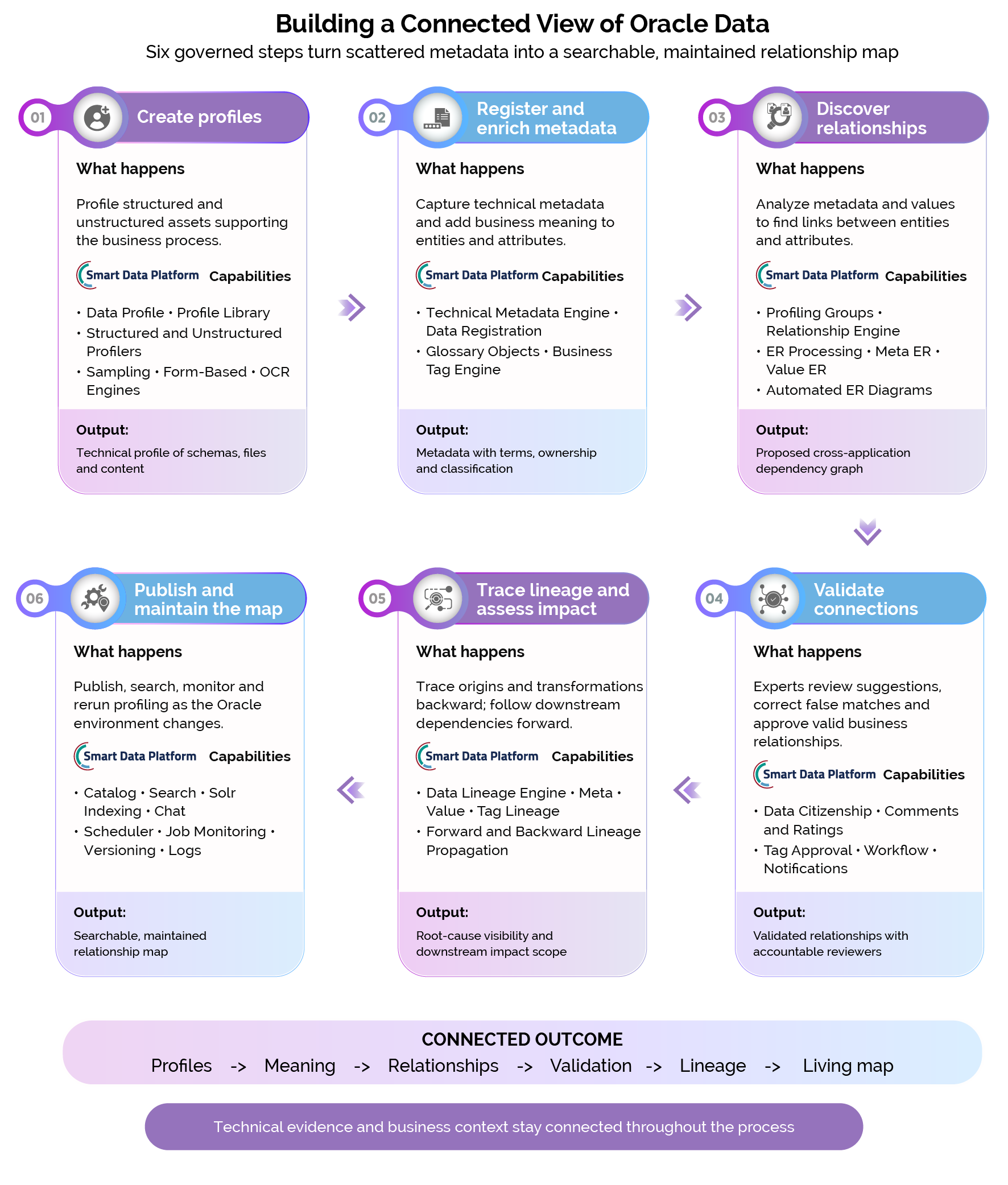
The relationship map is governed throughout its lifecycle. The Data Protection Engine, PII Tag Engine, Data Security Profile and row-level, column-level and role-based controls determine which assets each user can discover or access.
For example, when an Item Master attribute is changed, the Relationship Engine shows the connected entities. The Data Lineage Engine traces its movement and transformation, while forward lineage shows affected integrations, transactions, reports and analytical models. Owners can review the impact before release.
The result is a living map that answers four practical questions:
When hidden relationships become visible, organizations can:
Oracle applications may be managed as separate modules, but their data relationships cross application boundaries. A change to a master record, hierarchy, reference-data assignment or accounting rule can affect processes elsewhere in the landscape.
Mapping these relationships before a change allows teams to assess downstream impact, involve the right owners and validate affected processes. ChainSys Smart Data Platform supports this by connecting technical lineage with the business context needed to understand what changed and what could be affected next.
With that context, change remains controlled. Without it, dependencies are often discovered only after a process fails.
Find what an Oracle change will break before it goes live. Request a demo of ChainSys Smart Data Platform.
1. Why do Oracle applications not show these relationships directly?
Each screen supports a particular task. Cross-application relationships often operate through identifiers, configuration, rules and effective dates that are not presented as one visible path.
2. How is this different from master data management?
Master data management maintains trusted records for critical entities. Relationship mapping shows where those records are used, what depends on them and how a change travels across applications.
3. What is the practical difference between a business unit, a legal entity, and a ledger?
A business unit manages day-to-day transactions. A legal entity holds statutory and tax responsibility. A ledger records the financial impact using a defined chart of accounts, accounting calendar, currency, and accounting rules. Because a single transaction can involve all three, misunderstanding their roles can lead to security, accounting, and reporting issues.
4. Does mapping these relationships require changes to the source applications?
No. Metadata harvesting, cataloging, and lineage tracking examine how data is structured, connected, and moved across applications. They do not change how the source applications process transactions.