Turning Oracle Transaction Data Into Business Intelligence You Can Trust
Author:
Amarpal Nanda & Iswarya Tamilmani
Executive Summary
Up to 65% greater business outcomes. Gartner connects that advantage to organizations that have the most mature data and analytics capabilities for artificial intelligence (AI). For Oracle teams, the takeaway is simple: a dashboard can only be trusted when the data behind it is clearly defined, traceable, current, and properly secured. Many enterprises still treat that foundation as project documentation rather than an operating capability. This blog explains why that approach fails and how continuous metadata, governance, validation, monitoring, and automation turn Oracle transaction data into dependable business intelligence (BI).
The Enterprise Reality Check
The Dashboard Looks Fine but the Number Underneath It Does Not
Two people open what should be the same report. One shows revenue up 4%. The other shows it flat. Both use Oracle data, and neither calculation is obviously broken. They may be using different extracts, time windows, or definitions of revenue that were never governed in one place.
The issue becomes urgent during close, audit, forecasting, and AI adoption. Finance must reconcile reports because teams cannot quickly show a field's meaning, lineage, transformation, owner, or freshness.
The trust gap is measurable. Only 39% of technology leaders in the Gartner research expected current AI investments to improve financial performance. A 2025 Salesforce survey found confidence in data accuracy is down by 27% from its 2023 benchmark, while 54% of respondents were not fully confident in finding, analyzing, and interpreting data.
What Trusted Oracle Business Intelligence Means
Turning Oracle transaction data into trusted BI means converting operational events into metrics that retain their business meaning, source, transformation history, freshness, ownership, and permitted use. In an enterprise resource planning (ERP) environment, one event may span headers, lines, distributions, accounting entries, flex fields, and date-based records. A valid query becomes decision-ready only when its calculation and dependencies can be verified and its user is authorized.
Why the Project-Based Approach Is Failing
In the traditional approach, organizations document definitions, mappings, and controls during a reporting or migration project. It works until a field, hierarchy, instance, or pipeline changes; then documentation drifts from production.
The Repeating Cycle
Oracle data is extracted, and the business logic is rebuilt downstream.
Teams manually reconcile differences before publishing the report.
The final answer is documented as part of the project.
When a source, schema, or policy changes, the cycle starts again.
The dashboard may be accurate at launch, but there is no reliable way to prove it stays accurate.
The Shift Toward Continuous Data Intelligence
Reconciliation before go-live is no longer enough. Leaders must continually verify what each metric means, where it came from, who owns it, and whether it is safe to use.
This makes trusted business intelligence (BI) an ongoing capability, supported by governance, ownership, process controls, monitoring, and automation that keeps metadata and lineage current.
The Five Pillars of Sustainable Oracle Data Intelligence
Pillar
What it establishes
Why it matters
Smart Data Platform Capability
Governance
Approved definitions, policies, classifications, and quality rules
Metrics mean the same thing across teams
Business glossary, classifications, and policy rules
Ownership and stewardship
Named business and technical accountability
Issues reach the person who can resolve them
Catalog ownership and stewardship context
Prevention and process integration
Controls embedded in source systems and data pipelines
Defects are stopped before they reach reports
Profiling, validation, and pipeline controls
Visibility and monitoring
Lineage, freshness, usage, schema, and quality signals
Changes are detected before they affect decisions
Lineage, freshness, impact analysis, and alerts
Intelligent automation
Automated discovery, classification, impact analysis, and alerts
Governance scales without increasing manual work
Metadata discovery, relationship suggestions, and change detection
Common Challenges
Transaction complexity. Even technically correct joins can miss context spread across related Oracle objects.
Fragmented environments. Oracle Fusion Cloud, Oracle E-Business Suite, regional instances, and acquired systems often follow different calendars, hierarchies, and mappings.
Metric drift. Teams may rebuild key performance indicators (KPIs) within their own reports, leading to conflicting results.
Freshness gaps. A dashboard can appear current even when an extract or upstream dependency has failed.
Lineage and access gaps. As data moves through staging, transformations, semantic models, and visualizations, it becomes harder to trace its origin and confirm who should have access.
A Practical Roadmap
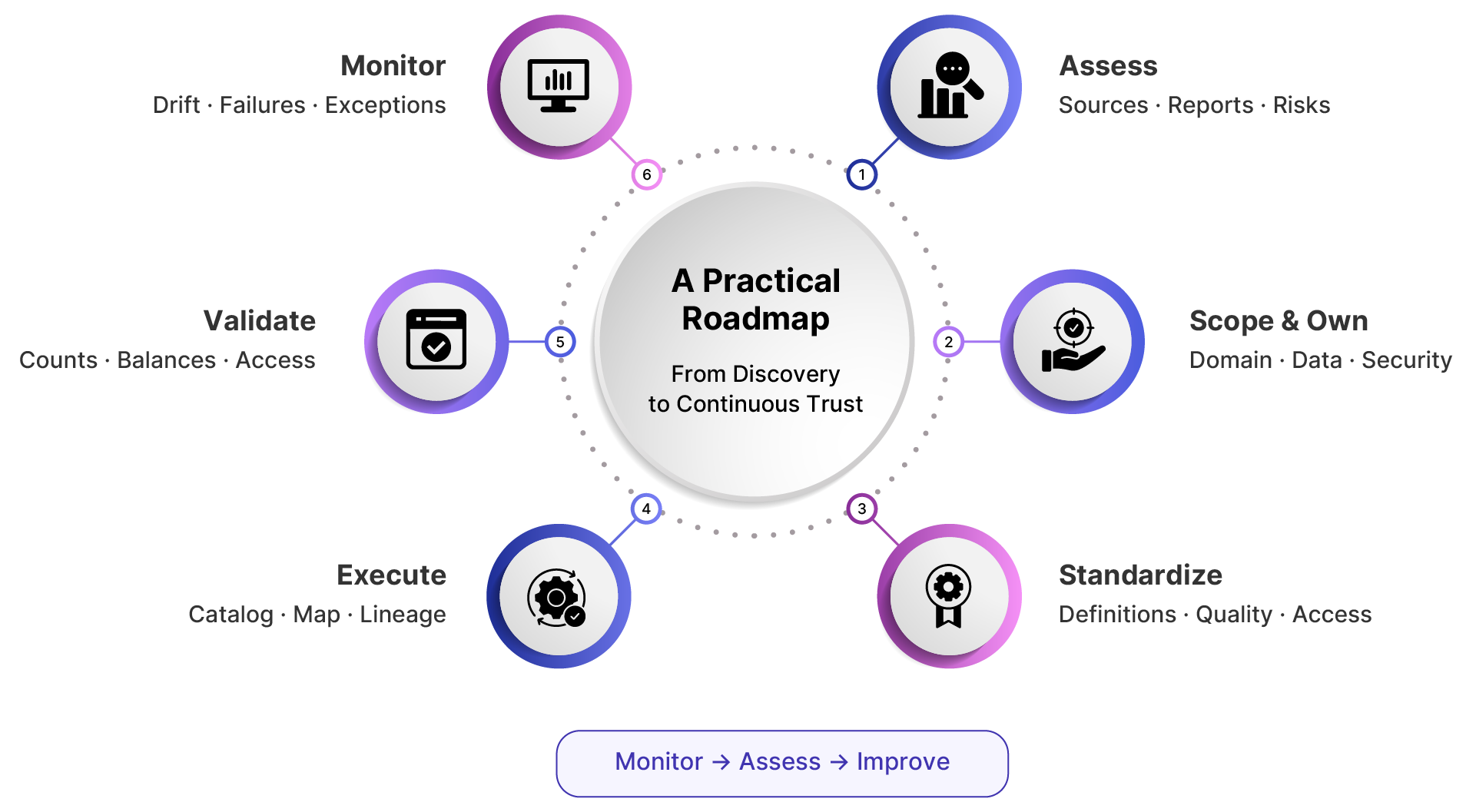
1. Assess. Take stock of the sources, reports, critical metrics, integrations, sensitive fields, and recurring reconciliation issues.
2. Define scope and ownership. Begin with one priority domain and name the people responsible for its metrics, data, and security.
3. Establish standards. Agree on definitions, classifications, quality thresholds, freshness expectations, access controls, and evidence requirements.
4. Execute. Use the Smart Data Platform to catalog Oracle assets, profile business objects, capture lineage, classify sensitive fields, and govern transformations.
5. Validate and reconcile. Compare record counts, balances, totals, transformation outputs, and user entitlements between the source and target.
6. Monitor continuously. Configure alerts for schema changes, failed refreshes, quality threshold breaches, policy updates, access exceptions, and broken lineage.
Technical Considerations
The controls should reflect how data moves from source to target. Teams need to preserve relationships between business objects, maintain versions of mappings and transformation logic, test data and access controls together, establish cutover baselines, and continue validation after go-live. The exact controls will vary across Oracle reporting paths.
Oracle reporting path
Best suited for
Control priority
Smart Data Platform role
Oracle Transactional Business Intelligence (OTBI)
Near-real-time analysis within Oracle subject areas
Shared metric definitions and security alignment
Catalog subject areas, connect fields to business terms, and document usage
Oracle Business Intelligence Cloud Connector (BICC)
Bulk extraction into a warehouse, lake, or downstream platform
Completeness, freshness, and dependency monitoring
Profile extracts, monitor delivery, validate record volumes, and capture lineage
Managed analytics pipelines
Curated data movement for enterprise analytics
Validation, lineage, and change-impact tracking
Version mappings, trace transformations, detect schema changes, and assess downstream impact
Maturity Model
Level
Operating pattern
What changes
Level 1: Reactive
Definitions and issues are addressed after disputes arise
Trust depends on individual knowledge
Level 2: Project-driven
Metadata and controls are documented for each initiative
Results improve temporarily, but drift returns
Level 3: Managed
Priority domains use defined owners, standards, cataloging, lineage, and validation
Metrics become repeatable and auditable
Level 4: Continuous
Changes, quality, freshness, access, and usage are monitored automatically
Trusted data becomes an enterprise capability
Business Impact
Lower risk. Verify important figures before making a decision.
Faster adoption. Spend less time debating which report is correct.
Consistent reporting. Keep key performance indicators (KPIs) aligned across functions.
Stronger compliance. Maintain access records, lineage, and audit evidence.
Artificial intelligence readiness. Give agents governed context instead of isolated values.
Greater efficiency. Replace repeated manual reconciliation with continuous monitoring.
How ChainSys Smart Data Platform Fits
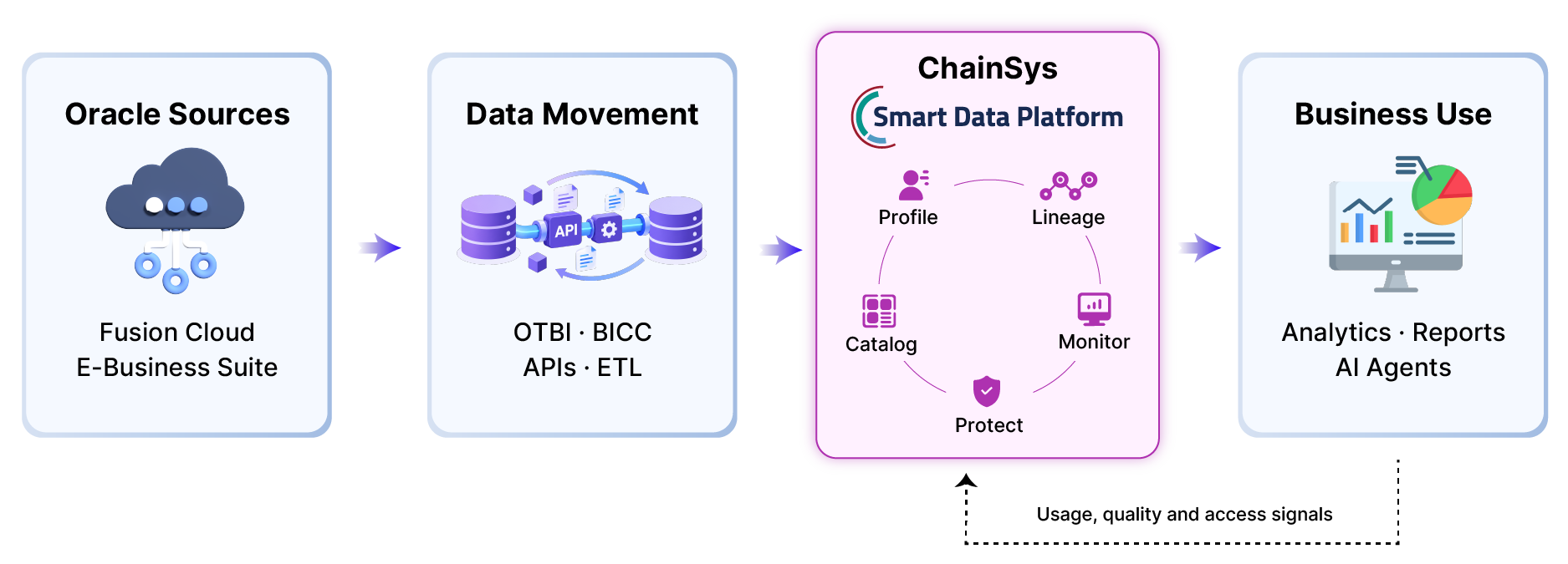
The ChainSys Smart Data Platform adds continuous control around Oracle transaction data and complements Oracle Analytics Cloud, Oracle Fusion Data Intelligence, and existing reporting tools.
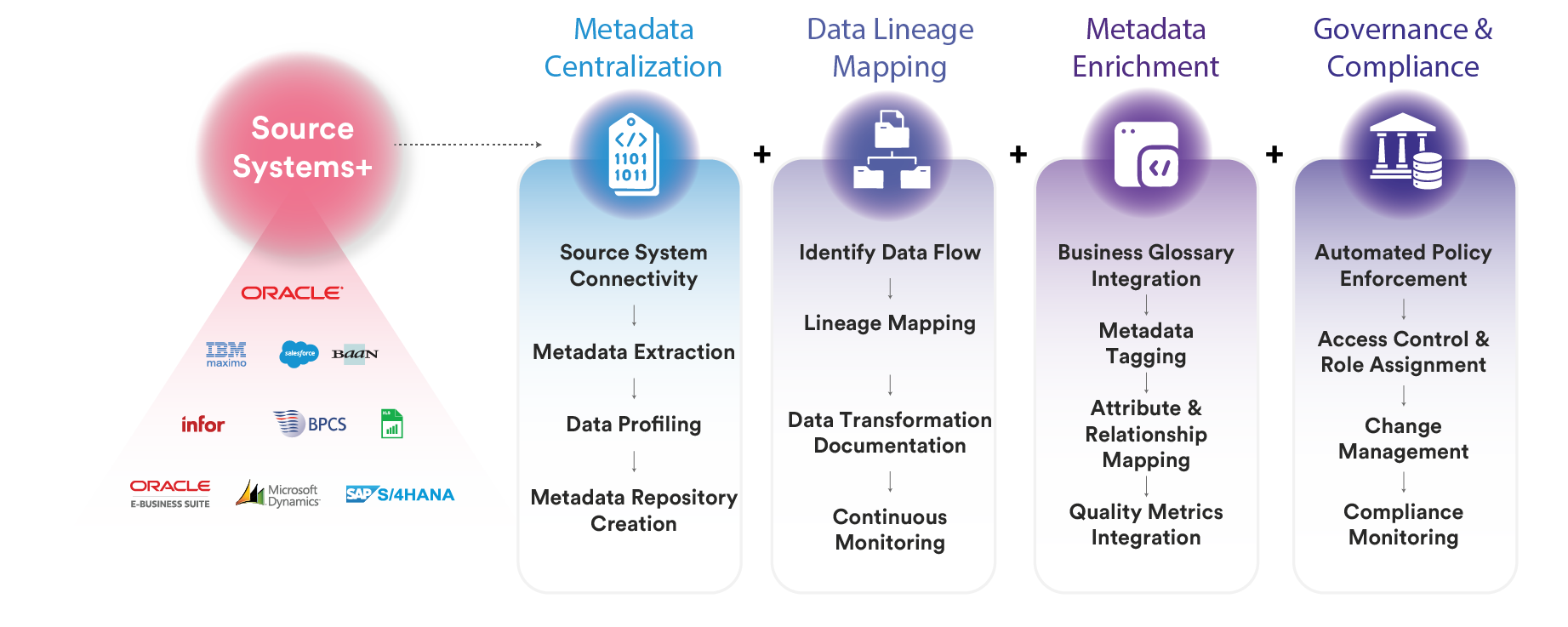
Discover and catalog. Harvest metadata from databases, enterprise applications, cloud platforms, and data lakes into searchable data dictionaries and business glossaries.
Profile and trace. Examine structured and unstructured assets, identify patterns and probable relationships, and trace data from source through transformation and use.
Monitor and operationalize. Embed profiling in extract, transform, and load (ETL) workflows; use alerts and metadata suggestions to identify changes and exceptions.
Classify and protect. Identify personally identifiable information (PII) and apply masking, anonymization, encryption, or access controls.
Treat trusted Oracle business intelligence (BI) as an ongoing business capability, not a reporting project.
Start with critical metrics before a migration, analytics expansion, or AI rollout.
Assign clear business, data, and security ownership.
Connect governance rules to source processes and transformations.
Prevent issues at the source, automate repeatable checks, and monitor continuously.
Readiness Checklist
Scope: Priority domains, systems, reports, and metrics identified
Ownership: Business, technical, data, and security owners assigned
Governance: Definitions, standards, classifications, and policies approved
Assessment: Objects, mappings, transformations, quality, and access risks profiled
Validation: Reconciliation rules, thresholds, and evidence defined
Risk: Dependencies, sensitive data, and change impacts documented
Monitoring: Freshness, lineage, quality, access, and schema changes tracked
Measurement: Trust, resolution time, manual effort, and adoption monitored
Frequently Asked Questions
What does trusted Oracle BI mean? Each metric retains its definition, lineage, freshness, ownership, security context, and transformation history.
Why does it matter? Without that context, organizations face inconsistent decisions, slow reconciliation, and automation they cannot safely trust.
Who owns it? Business, data, application, and security teams each have clearly defined responsibilities.
What are the main challenges? Complex Oracle objects, multiple instances, latency, metric drift, incomplete lineage, and inconsistent access controls.
How should an organization begin? Start with one high-value domain, assign owners, agree on standards, validate the data, and monitor it continuously.
How does ChainSys Smart Data Platform help? It catalogs Oracle assets, maintains metadata and lineage, profiles quality, monitors change, and protects sensitive data across reporting and AI workflows.
Closing Thought
Oracle transaction data becomes valuable when teams can rely on it at the moment of decision. Continuous control strengthens reporting today and creates a safer foundation for AI-driven operations.
Is your Oracle data ready to support trusted analytics and AI?Talk to ChainSys about a focused metadata, analytics, and governance assessment.